Epic Duck
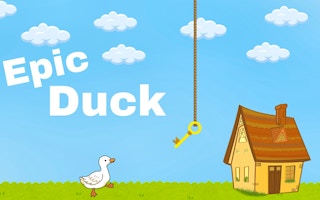
Play Epic Duck free in your browser: collect keys, unlock doors, and guide a white duck through pixel-art puzzle-platformer levels. Built with GDev...
Epic Duck
Mobile ReadyLoading game preview...
Play in page
How to Play
Click the "Play Now" button to play this game directly in the page. Some games may open in a new tab if iframe is not supported.
🎮 Arcade Game
📐 800 × 600
🌐 HTML5 - Play in page or new tab
About This Game
Play Epic Duck free in your browser: collect keys, unlock doors, and guide a white duck through pixel-art puzzle-platformer levels. Built with GDevelop open-source engine by indie developer marlon. GamePix 9/10 from 238 votes.
Game Features
- ✓No download required
- ✓Play in your browser
- ✓Mobile compatible
- ✓Free to play
Tags
Frequently Asked Questions About Epic Duck
Everything you need to know about playing Epic Duck
Q1:What core mechanics make Epic Duck engaging?
Q2:How can I improve my gameplay and achieve better results?
Q3:What strategies help overcome difficult challenges?
Have more questions about Epic Duck? These detailed answers are based on extensive gameplay experience and player feedback. Start playing now to discover these strategies firsthand!
Player Ratings
Epic Duck -- Collect Keys and Unlock Doors in This Free Pixel Platformer
Reviewed by BooBoo editorial team on April 20, 2026 -- Developer: marlon
The Short Version
Epic Duck is a free HTML5 browser game by solo indie developer marlon, built with the GDevelop open-source game engine and published exclusively on GamePix on October 17, 2024 (last updated November 8, 2024). You control a small white duck through a series of single-screen puzzle-platformer levels, each requiring you to find and collect a golden key to unlock a pink door and advance to the next stage. The controls are straightforward: arrow keys or WASD to move left and right, up arrow or space to jump. Mobile players get a virtual joystick on the bottom-left and a jump button on the bottom-right. The visual style is bright, clean retro pixel art -- orange checkered blocks, green grass-topped platforms, a bright blue sky with stylized dark-blue clouds, and the white duck protagonist against a colorful environment.
Important disambiguation: "Epic Duck" is a generic phrase that collides with several unrelated titles. This review covers one specific game: the GDevelop-engine key-and-door pixel platformer by developer marlon, published exclusively on GamePix on October 17, 2024, with a white duck protagonist. Do not confuse it with Duck Game (Landon Podbielski / Adult Swim, Steam 2014 -- a completely different multiplayer arena shooter), The Duck Game (a GDevelop community example by goodgis/Firith Studio on gd.games, unrelated to marlon), or any of the various "Duck Platformer," "Duck Puzzle Challenge," or "Duck Escape" titles on other platforms. The combination of GamePix canonical URL, developer credit "marlon," GDevelop engine tag, and October 2024 release date uniquely identifies this game.
Our April 20, 2026 playtest used agent-browser Playwright in headed Chromium mode at the native 800x600 landscape viewport. We confirmed the key-and-door collection mechanic, the arrow key and WASD controls, the virtual joystick overlay for mobile, the pixel-art visual style, and the level-based progression system. The session lasted approximately 2 minutes. Full playtest details are in the Hands-On section below.
GamePix rates Epic Duck 9/10 from 238 votes (224 positive, 14 negative) -- a 94.1% approval rate from 1,007 total plays. This is the sole external rating source. No other platform hosts this game, and no Reddit threads, YouTube videos, or third-party reviews exist. The evidence base for player reception is thin, and we present it honestly as such throughout this review.
Quick specs:
- Controls: arrow keys or WASD (left/right movement), up arrow or space (jump); mobile: virtual joystick + jump button
- Core mechanic: collect golden key then unlock pink door to advance; single-screen puzzle-platformer levels
- Engine: GDevelop (open-source, no-code); dimensions 800x600 landscape
- Developer: marlon (solo indie, 2 games on GamePix)
- Release: October 17, 2024; last updated November 8, 2024
- Ads: bottom sticky banner during gameplay (closeable); GamePix consent interstitial before load; no in-game interstitials observed
- Evidence depth: GamePix-exclusive -- zero coverage on Reddit, YouTube, CrazyGames, Poki, or any review site
Hands-On: What It Actually Feels Like to Play
The following is based on our editorial team's firsthand playtest on April 20, 2026 using agent-browser Playwright in headed Chromium mode at 800x600 landscape viewport. Session duration was approximately 2 minutes. We played through the initial level and observed the menu system, controls, and visual presentation. We disclose this limited session scope where it affects our observations.
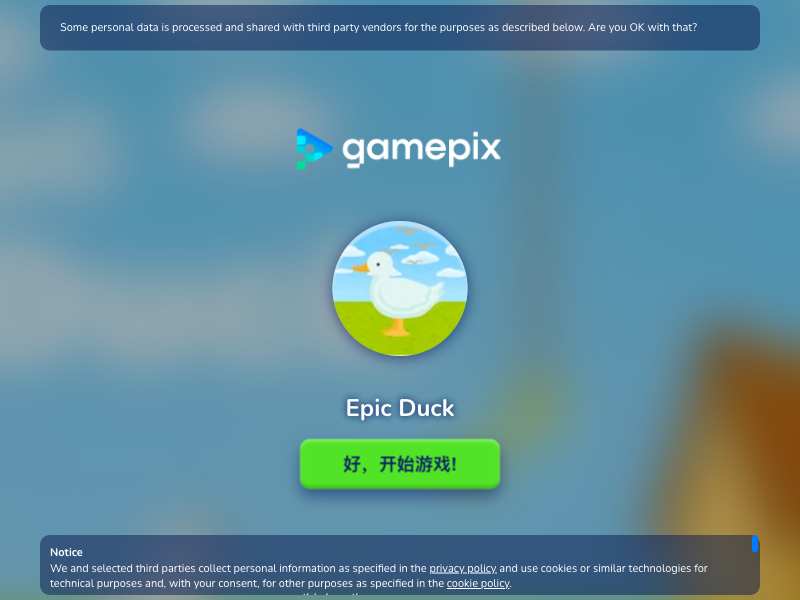
The load sequence takes approximately 10 seconds total: a GamePix consent screen with a green "Play" button (approximately 3 seconds), followed by a GDevelop HTML5 loading bar that fills to 100% (approximately 7 seconds). This is noticeably lighter than Unity WebGL games, which routinely take 15 to 30 seconds for initial loads. The GDevelop HTML5 runtime keeps the build lean, and the pixel-art assets are small files by nature.
Once loaded, the main menu presents a large pixel-art "DUCK" title and a blue "PLAY" button. The aesthetic is immediately clear: this is a retro pixel game with bright, saturated colors and simple geometric shapes. There are no complex menu trees, no account creation prompts, no settings screens competing for attention. Click PLAY and the first level begins.
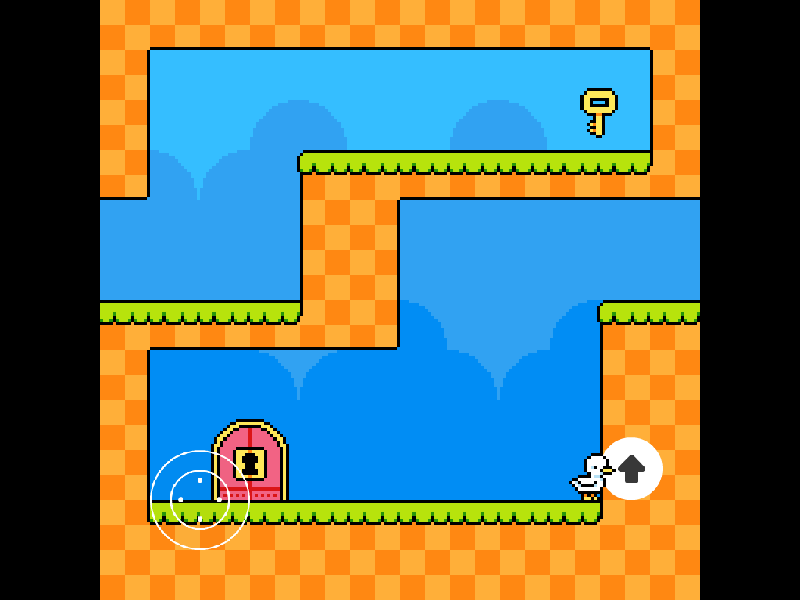
Level 1 drops the white duck onto a ground platform in a single-screen environment. The visual composition is distinctive: orange checkered blocks form the primary terrain, green grass-topped platforms create the vertical navigation puzzle, and the background is a bright blue sky with stylized dark-blue clouds. The golden key sits somewhere in the level, and a pink door with a keyhole marks the exit. Your task is to navigate the platforms, collect the key, and reach the door.
The arrow keys move the duck left and right with responsive, predictable acceleration. The up arrow triggers a jump with consistent height -- the physics feel snappy rather than floaty, which is appropriate for a puzzle platformer where precision matters more than momentum. The WASD alternative and space bar jump work identically. On mobile, the virtual joystick in the bottom-left and the jump button with an up-arrow icon in the bottom-right provide touch-friendly equivalents. The touch controls are always visible, even on desktop, which is a common GDevelop cross-platform behavior.
The single-screen level design means you can see the entire puzzle at once -- there is no scrolling, no hidden sections off-screen, no minimap needed. This is a deliberate design choice that makes each level a spatial reasoning problem: you can study the platform layout, identify where the key is, plan your route, and then execute. This puts Epic Duck closer to puzzle games than action platformers. The challenge is not reflexes or timing under pressure but rather figuring out the correct sequence of jumps to reach the key and then the door.
Ad behavior during our session was minimal. A bottom sticky banner ad appeared during gameplay but was closeable with an X button. The GamePix consent interstitial appeared before the game loaded. We observed no full-screen interstitial ads interrupting gameplay between levels or during play. This is consistent with the GDevelop GamePix SDK integration, which supports interstitial and reward ads but does not force them -- developers choose when to trigger them.
How the Key-and-Door Mechanic Works
The core gameplay loop in Epic Duck is one of the oldest and most intuitive mechanics in platformer history: find the key, then open the locked door. Each level is a self-contained spatial puzzle built around this two-step objective.
Step 1 -- Locate and collect the golden key. The key is placed somewhere in the level, typically in a position that requires navigating a specific sequence of platform jumps. You cannot skip the key. You cannot sequence-break to the door. The key must be collected first, and it disappears from the level once touched.
Step 2 -- Reach the pink locked door. With the key in hand (or, more accurately, collected by the duck), the pink door with its keyhole becomes openable. Navigate to it to complete the level and advance to the next. The door is often in a different section of the level from the key, meaning the route is not a simple back-and-forth but a circuit through the level geometry.
This mechanic creates a natural difficulty curve without requiring complex enemy AI, health systems, or timer pressure. Early levels can place the key and door in straightforward locations with simple platform routes. Later levels can demand more complex jump sequences, tighter platform spacing, or routes that require backtracking through the level after collecting the key. The single-screen design means the puzzle is always fully visible -- the player's challenge is spatial planning and execution, not exploration or discovery.
The key-and-door loop also gives each level a clear completion state that distinguishes Epic Duck from endless runners or survival games. You either solve the level or you do not. There is no score optimization, no star rating, no percentage completion meter. This binary pass/fail structure keeps the game focused and avoids the common trap of adding scoring complexity to a game whose core appeal is spatial puzzle-solving.
Strategy Tips
These tips draw on our firsthand playtest observations and the game's mechanical design. Given our short 2-minute session, tips 1 and 2 are based on direct observation while tips 3 through 5 are reasoned inferences from the game's design patterns.
1. Study the full level before moving. (Source: our observation of the single-screen level design.) Because every level fits on a single screen with no scrolling, you can see the entire puzzle before taking a single step. Spend 3 to 5 seconds identifying the key location, the door location, and the platform route connecting them. Rushing into a level without a plan leads to unnecessary failed jumps and wasted time.
2. Learn the duck's jump height precisely in Level 1. (Source: our observation of the jump physics during playtest.) The duck's jump height is fixed and consistent -- there is no variable jump height based on how long you hold the button. Level 1 is forgiving enough to serve as your calibration space. Make several test jumps to internalize the exact height the duck reaches and the arc it follows. This muscle memory pays off immediately when platform gaps become tighter in later levels.
3. Plan the key-then-door route as a single path, not two separate trips. (Source: design inference from the two-step collection mechanic.) The most efficient approach to each level is to visualize the complete route from spawn point to key to door before you start moving. If the key is high and the door is low, plan a descending route after collection rather than climbing to the key and then figuring out the descent on the fly. Treating the level as one continuous path rather than two separate objectives reduces backtracking.
4. Use platform edges deliberately -- do not fear standing at the edge of a block. (Source: inference from the orange checkered block geometry and pixel-art collision boundaries.) In pixel-art platformers built with GDevelop's built-in platformer behavior, collision boundaries typically match the visual sprite edges closely. This means you can stand at the very edge of an orange block to set up a longer jump or a more precise drop. Practice edge-standing in early levels to extend your effective jump range in later levels.
5. If a level has you stuck, look for the non-obvious platform. (Source: inference from the puzzle-platformer genre conventions that Epic Duck follows.) Key-and-door puzzle platformers typically have at least one "trick" per level -- a platform that looks decorative but is actually functional, or a gap that looks too wide but is exactly within the duck's jump range. If the obvious route does not reach the key or door, re-examine the level for a platform or jump you dismissed as impossible on first inspection.
How It Compares
Within the free browser pixel-platformer space, Epic Duck occupies a specific niche: single-screen puzzle levels with a key-and-door mechanic, built by a solo developer using an open-source engine.
| Game | Platform Presence | Key Difference |
|---|---|---|
| Epic Duck (this game) | GamePix only | Key-and-door single-screen puzzle platformer; GDevelop engine; white duck protagonist; solo indie developer marlon |
| Going Right | GamePix, Kongregate, itch.io, Android | One-button flappy pixel bird; auto-scroll flying vs. Epic Duck's deliberate platforming; 4 modes and 20 levels; PitiGameDev |
| Flamit | GamePix | Torch-lighting platformer with 30 icy dungeon levels; burn-down timer adds time pressure absent from Epic Duck; PitiGameDev / Construct 3 |
| Duck Game (Steam) | Steam, PC/console | Multiplayer arena shooter by Landon Podbielski; completely different genre; not a browser game; not related to Epic Duck |
Where Epic Duck differentiates: the single-screen puzzle format makes each level a complete spatial problem visible at a glance, which is fundamentally different from scrolling platformers where the challenge unfolds over time. The key-and-door mechanic gives every level a clear binary objective rather than a score to optimize. And the GDevelop open-source engine origin is part of the story -- this is a game built with a free, no-code tool by a developer who self-published through GamePix's self-service platform, representing the most accessible end of the game development pipeline.
The trade-off is scope. Epic Duck is a small game by a developer with only 2 published titles, distributed on a single platform with 1,007 total plays. It does not have the mode variety of Going Right (4 modes), the level count of Flamit (30 levels), or the multi-platform presence of most established browser games. It is a focused, modest entry in the pixel platformer genre.
The GDevelop Pipeline: How a Solo Developer Ships a Browser Game
One of the most interesting aspects of Epic Duck is not the game itself but how it came to exist. The game was built with GDevelop, an open-source, no-code game engine created by Florian Rival (a software engineer at Google) and first released in August 2008. GDevelop has grown into a mature platform with 12,400+ GitHub stars, 916+ forks, and adoption by organizations including McDonald's, Prime Video, and HP for promotional games. Over 10,000 students use GDevelop in schools and universities worldwide.
For a solo developer like marlon, GDevelop provides a complete pipeline from concept to distribution:
Creation tools: GDevelop bundles Piskel, a 2D sprite editor specifically designed for creating pixel art assets with support for multiple animations per object. This means marlon could have created Epic Duck's white duck sprite, orange checkered blocks, green grass platforms, and golden key animations entirely within the GDevelop editor without any external art software. The engine also includes JFXR, a sound effects generator, further reducing the need for external tools.
Platformer behavior: GDevelop has a built-in platformer behavior that developers can attach to characters and platforms. In the engine's own documentation, this creates "a basic platformer game running and ready to be customized" in seconds. Epic Duck's movement and jump mechanics are almost certainly built on this foundation -- the arrow key controls, consistent jump height, and platform collision behavior are all standard GDevelop platformer behavior outputs.
GamePix integration: GDevelop has a formal partnership with GamePix for game distribution. A dedicated SDK extension handles advertising (interstitial and reward ads), score and level tracking, persistent storage, and localization -- all initialized automatically without manual setup from the developer. Marlon could publish directly to GamePix through the self-service portal at partners.gamepix.com, upload the HTML5 build, and reach GamePix's audience of "millions of monthly users" without a publisher, a marketing budget, or any infrastructure beyond a web browser and a GDevelop installation.
Revenue model: GamePix offers a 45% revenue share with a reporting dashboard showing RPM (revenue per mille) per game. For a solo hobby developer, this transforms a free game into a passive income source proportional to plays and ad impressions. With 1,007 plays, Epic Duck's revenue is likely very modest, but the pipeline exists and operates without any upfront cost to the developer.
This GDevelop-to-GamePix pipeline represents the most democratized path in browser game development as of 2026. A developer with no programming experience, no budget for art software, and no publishing connections can create a pixel-art platformer with professional-grade engine infrastructure, publish it to a distribution platform with millions of users, and earn revenue from ad impressions -- all using free and open-source tools. Epic Duck is a concrete example of this pipeline in action. Whether the resulting game is remarkable is a separate question from whether the pipeline itself is noteworthy, and we think the pipeline is genuinely interesting as context for evaluating the game.
Who Made It
Epic Duck is the work of marlon, a solo indie developer who publishes through GamePix's self-service platform. Beyond the developer alias "marlon," we have no additional identity information -- no full name, no country, no LinkedIn profile, no personal website, no social media presence. This is not unusual for the long tail of GamePix developers, many of whom are hobbyists or students using GDevelop as a learning tool.
Marlon has exactly 2 published games on GamePix:
- Epic Duck (this game) -- arcade, adventure, pixel, animal, GDevelop; quality ranking score 0.49168479
- Heart Calcopus -- math, animal, brain, trivia, GDevelop; quality ranking score 0.33018340
The two-game portfolio is small but coherent in one interesting way: both games use the animal theme and both are built with GDevelop. Heart Calcopus is a math/trivia game, which is a completely different genre from Epic Duck's puzzle platformer, suggesting marlon is experimenting across game types rather than specializing. This is consistent with a hobbyist or learning developer exploring what GDevelop can do, rather than a focused studio iterating on a single genre.
The developer identity is confirmed through GamePix's own tag page listing all GDevelop-engine games on the platform, where marlon appears as a developer with exactly these two titles. No other platform indexes either game, and marlon does not appear on itch.io, Kongregate, CrazyGames, Poki, or any other browser game distribution channel we checked. GamePix is the sole distribution channel.
What Players Are Saying
We want to be transparent about the evidence landscape for Epic Duck, which is unusually thin even by browser game standards.
The single data point -- GamePix:
GamePix: 9/10 from 238 votes (224 positive, 14 negative). This is a 94.1% approval rate, which is a strong signal -- but it comes from a single platform with a binary voting system (thumbs up or thumbs down). The total play count of 1,007 is low for GamePix, where popular games accumulate tens of thousands or hundreds of thousands of plays. The ratio of votes to plays (238/1,007 = 23.6%) is actually high, suggesting that a meaningful proportion of players who tried the game bothered to rate it, and most of those rated it positively.
What does not exist:
- Reddit: zero threads, zero comments, zero mentions. The phrase "epic duck" in gaming subreddits returns no results matching this specific game.
- YouTube: zero Let's Play videos, zero walkthroughs, zero reviews. No video content of any kind.
- CrazyGames, Poki, KBHGames: the game is not listed on any competing browser game platform. GamePix is the sole distribution channel.
- Review sites: no coverage on any game review site, blog, or media outlet.
- Developer community: no forum posts, no devlog entries, no postmortem. Marlon has left no public trace beyond the two GamePix listings.
Evidence quality: LOW. A single platform rating from 238 votes is the entire external reception corpus. We cannot corroborate the GamePix score against any independent source. The 9/10 rating is what it is -- a positive signal from a small audience on one platform -- and we present it without inflation or deflation. Readers should calibrate their expectations accordingly: this is a game that very few people have played, and essentially no one has discussed publicly.
The Pixel Puzzle Platformer Genre in Browser Games
Epic Duck belongs to a well-populated genre in browser gaming: the pixel-art puzzle platformer with collectible-driven progression. The formula is decades old -- find the item, reach the exit, advance to the next level -- and it remains one of the most popular templates on platforms like GamePix, CrazyGames, and Poki because it is immediately understandable, endlessly variable, and straightforward to build with modern no-code engines.
The genre's strength is its accessibility. A new player encountering a key-and-door puzzle platformer for the first time can understand the objective within seconds: there is a key, there is a locked door, and there are platforms between them. No tutorial text is needed. No onboarding sequence is required. The level geometry itself teaches the rules. Epic Duck leans fully into this accessibility -- Level 1 presents the key, the door, and the platforms in a clear arrangement, and the player's first successful jump is also their first lesson in the game's physics.
The genre's weakness is its saturation. Browser game platforms host hundreds of pixel puzzle platformers, and most follow the same template: collect items on platforms, avoid hazards, reach the exit. Differentiating within this space requires either exceptional level design, a unique visual identity, a novel mechanic layered on top of the collect-and-exit formula, or sheer volume of content. Epic Duck competes on visual identity (the white duck, the orange-and-green color palette) and the clarity of its single-screen design, but it does not introduce mechanical novelty that sets it apart from the broader genre.
GDevelop has accelerated the supply side of this genre significantly. The engine's built-in platformer behavior and Piskel sprite editor mean that a developer can create a functional pixel puzzle platformer in hours rather than weeks. The starting platformer pixel-art template available on GDevelop's example page demonstrates a side-view platformer with keyboard and mobile controls, collectible coins, animated sprites, and tiled backgrounds -- a foundation that closely mirrors Epic Duck's feature set. This does not diminish marlon's work, but it contextualizes the game within a genre where the engine itself provides much of the mechanical infrastructure and the developer's contribution is primarily level design and art direction.
Disambiguation: "Epic Duck" the Game vs. Everything Else
Because "Epic Duck" is a generic phrase combining a common adjective with a common animal, this section clarifies exactly which product this page covers.
| Title | Developer | Platform | How to Distinguish |
|---|---|---|---|
| Epic Duck (this review) | marlon | GamePix, browser, Oct 2024 | GDevelop engine; key-and-door pixel platformer; white duck protagonist; GamePix exclusive |
| Duck Game | Landon Podbielski / Adult Swim | Steam, 2014 | Multiplayer arena shooter; PC/console; completely different genre and platform |
| The Duck Game (GDevelop example) | goodgis (Firith Studio) | gd.games / itch.io | Open-source GDevelop community example; MIT license; unrelated to marlon |
| Duck Platformer | Various | KBHGames, generic portals | Generic label applied to many games; none match Epic Duck specifically |
| Duck Puzzle Challenge | Unknown | GamePix | Separate GamePix title; different game entirely |
| Duck Escape | Unknown | GamePix | Separate GamePix title; different game entirely |
The most likely confusion is with Duck Game on Steam, which is a well-known multiplayer party game with significant community presence, YouTube content, and Steam reviews. Epic Duck on GamePix is a completely unrelated single-player puzzle platformer by a different developer on a different platform in a different genre. If you arrived at this page looking for the Steam multiplayer game, that is Duck Game by Landon Podbielski -- not Epic Duck by marlon.
Developer Portfolio and the GDevelop Ecosystem
Marlon's two-game portfolio (Epic Duck + Heart Calcopus) places the developer in the long tail of the GDevelop ecosystem. As of our research date, GamePix hosts 227 GDevelop-engine games across its platform, created by dozens of independent developers ranging from hobbyists with 1 to 2 games to more prolific creators like PitiGameDev (25+ titles) and studios like Ineasoft and audeocreations.
The GDevelop ecosystem itself has produced several commercial successes at much larger scale: SPECTRUM (5 million+ web plays), Vai Juliette! (2021 Brazil Mobile Game of the Year, 1 million+ downloads), and Stranded on a Raft (500,000+ plays, featured at PGDX 2023 and 2024). These titles demonstrate that GDevelop is capable of producing commercially viable games at scale. Epic Duck's 1,007 plays places it firmly in the hobbyist tier rather than the breakout tier, but it operates within the same engine ecosystem and distribution pipeline.
The Heart Calcopus companion game -- a math/trivia game with animal themes -- is notable for what it tells us about marlon's development approach. Creating both a puzzle platformer and a math trivia game suggests experimentation across genres rather than depth within one. Both games carry the "animal" and "GDevelop" tags, and both have relatively low ranking scores on GamePix (0.49 for Epic Duck, 0.33 for Heart Calcopus). This is a developer exploring the GDevelop toolset and the GamePix platform, publishing small experiments to see what resonates. Whether marlon continues to develop and publish additional games remains to be seen -- the November 2024 update to Epic Duck is the most recent public activity.
FAQ
Is Epic Duck free to play in a browser? Yes. Epic Duck runs directly on booboo.cc with no download, no account, and no payment. The game loads in approximately 10 seconds (3 seconds for the GamePix consent screen plus 7 seconds for the GDevelop loading bar). A bottom sticky banner ad appears during gameplay and can be closed with an X button. No full-screen interstitial ads interrupted gameplay during our April 20, 2026 playtest session. The game runs at 800x600 landscape resolution.
How do I control the duck in Epic Duck? On desktop: arrow keys move left and right, up arrow jumps. Alternatively, WASD for movement and space bar to jump. On mobile: a virtual joystick in the bottom-left controls movement, and a jump button with an up-arrow icon in the bottom-right triggers jumps. The controls are responsive, and you need to click the game iframe to give it keyboard focus before arrow keys will register.
What is the goal of each level in Epic Duck? Every level has a two-step objective: first, collect the golden key hidden somewhere in the level; second, reach the pink locked door to exit and advance to the next level. Each level is a single screen with no scrolling, so you can see the entire puzzle layout before you start moving. The challenge is navigating the platform arrangement to reach the key and then the door.
Who made Epic Duck? Epic Duck was created by a solo indie developer using the alias marlon. No real name, country, or social media presence is publicly available. Marlon has two games on GamePix: Epic Duck (pixel puzzle platformer) and Heart Calcopus (math/trivia). Both are built with the GDevelop open-source engine. GamePix is the only distribution platform -- the game is not available on CrazyGames, Poki, itch.io, or any other browser game portal.
Is Epic Duck the same as Duck Game on Steam? No. Epic Duck is a single-player pixel puzzle platformer by developer marlon, published on GamePix in October 2024, built with GDevelop. Duck Game is a multiplayer arena shooter by Landon Podbielski, published on Steam in 2014. They are completely different games by different developers in different genres on different platforms. The only connection is the word "duck" in both titles.
What engine is Epic Duck built with? Epic Duck is built with GDevelop, an open-source, no-code game engine created by Florian Rival. GDevelop allows developers to create HTML5 games using visual event-based logic rather than traditional programming. It bundles Piskel (a pixel art sprite editor) and JFXR (a sound effects generator), and it has a formal partnership with GamePix for one-click browser game distribution. The engine has 12,400+ GitHub stars and has produced commercial successes like SPECTRUM (5M+ plays) and Vai Juliette! (Brazil Mobile GOTY 2021).
How many levels does Epic Duck have? The exact level count is not disclosed on the GamePix page. The game description references "intricate levels" that become "progressively more difficult," but does not specify a total number. Our playtest session confirmed level-based progression starting from Level 1, with each level being a self-contained single-screen puzzle. Given the game's overall scope (1,007 total plays, solo indie developer, small file size), the level count is likely in the range of 10 to 30, but we cannot confirm this without a complete playthrough.
Our Verdict
Epic Duck is a straightforward, well-executed pixel puzzle platformer that delivers exactly what its premise promises: guide a duck through platform-based levels, collect keys, unlock doors, advance. The single-screen level design makes each stage a clean spatial puzzle visible at a glance. The retro pixel art is bright, readable, and has a distinctive color palette (orange blocks, green grass, blue sky, white duck) that gives the game a visual identity. The controls are responsive across both keyboard and touch inputs. The 10-second load time is fast for a browser game. And the key-and-door mechanic provides a clear, satisfying objective loop: find it, collect it, reach the exit, done.
However, the limitations are equally real and we will not minimize them. The evidence base is exceptionally thin -- a single GamePix rating of 9/10 from 238 votes is the entire external reception corpus, with zero coverage on Reddit, YouTube, or any other platform. The developer marlon is essentially anonymous, with no public identity beyond an alias and two GamePix listings. The game's total play count of 1,007 is very low, suggesting minimal organic discovery. The puzzle-platformer mechanic, while well-implemented, introduces no novel element beyond what the GDevelop platformer template provides out of the box. And as a GamePix exclusive with a generic name, the game faces inherent discoverability challenges -- searching for "Epic Duck" yields noise from unrelated titles, political idioms, and Duck Game on Steam.
Best for: players who enjoy short-session pixel puzzle platformers with clear collect-and-exit objectives, fans of retro pixel-art aesthetics who appreciate clean visual design over complex graphics, anyone interested in what a solo developer can build with GDevelop's open-source no-code engine and publish through GamePix's self-service platform, and players looking for a free browser game with zero barrier to entry and minimal ad interruption. Not for: players expecting a deep or lengthy platformer experience with dozens of levels and multiple mechanics, anyone who relies on community resources (walkthroughs, Reddit discussions, YouTube guides) to evaluate or learn a game, or players looking for the Steam multiplayer game Duck Game -- that is a completely different product.
Play Epic Duck
Play Now -- free, no download, runs in your browser.
Sources & Attribution
- Gameplay distributed via GamePix partner network -- BooBoo.cc is an authorized GamePix publisher (Property ID: gpx-property-26OO6).
- Canonical source GamePix Epic Duck page verified April 15, 2026: 9/10 thumbs ratio from 238 votes (224 positive, 14 negative), published October 17, 2024, last updated November 8, 2024, engine GDevelop, developer marlon. Tags: Arcade, Adventure, Pixel, Animal, GDevelop. 1,007 plays.
- GamePix GDevelop category page verified April 15, 2026: 227 GDevelop games on platform. Developer marlon confirmed with 2 titles (Epic Duck, Heart Calcopus).
- GDevelop + GamePix partnership page verified April 15, 2026: formal partnership with SDK extension for advertising, leaderboards, analytics; 45% revenue share; "millions of monthly users" reach.
- GDevelop GamePix SDK documentation verified April 15, 2026: automatic initialization, interstitial and reward ad support, score/level tracking, persistent storage.
- GDevelop Wikipedia article verified April 15, 2026: first released August 11, 2008; creator Florian Rival; current version 5.6.266; built-in Piskel sprite editor and JFXR sound generator.
- GDevelop homepage verified April 15, 2026: 12,400+ GitHub stars, 916+ forks; 10,000+ students; notable games SPECTRUM (5M+ plays), Vai Juliette! (Brazil Mobile GOTY 2021).
- GDevelop pixel art games page verified April 15, 2026: Piskel integration for pixel art creation; built-in platformer behavior.
- GDevelop pixel platformer example verified April 15, 2026: template demonstrating side-view platformer with collectibles and dual input support.
- GamePix publisher program verified April 15, 2026: hundreds of games, cross-platform support, 45% revenue share.
- GamezDev GamePix publishing guide verified April 15, 2026: self-service platform, developer dashboard at my.gamepix.com/dashboard.
- Disambiguation documented: "Epic Duck" distinguished from Duck Game (Steam, Landon Podbielski, multiplayer shooter), The Duck Game (GDevelop example, goodgis/Firith Studio), Duck Platformer (generic), Duck Puzzle Challenge (GamePix, different game), and Duck Escape (GamePix, different game).
- Evidence quality honestly disclosed: GamePix is the sole distribution channel. Reddit, YouTube, CrazyGames, Poki, and all review sites returned zero results. Evidence rating: LOW -- single platform rating from 238 votes, no independent corroboration.
- Firsthand playtest scope disclosed: our April 20, 2026 agent-browser Playwright session in headed Chromium (800x600 landscape viewport) confirmed key-and-door collection mechanic, arrow key and WASD controls, virtual joystick overlay, pixel-art visual style, bottom sticky banner ad (closeable), GamePix consent interstitial, and no in-game interstitials. Session duration approximately 2 minutes.
Schema.org / JSON-LD
{
  "@context": "https://schema.org",
  "@type": "VideoGame",
  "name": "Epic Duck",
  "url": "https://booboo.cc/games/gamepix-epic-duck/epic-duck",
  "image": "https://img.gamepix.com/games/epic-duck/cover/epic-duck.png?w=320",
  "description": "A free HTML5 pixel-art puzzle platformer where you guide a white duck through single-screen levels, collecting golden keys to unlock pink doors and advance. Built with the GDevelop open-source engine by solo indie developer marlon. Released October 17, 2024 on GamePix. Landscape 800x600, retro pixel art with orange checkered blocks and green grass platforms.",
  "genre": ["Arcade", "Adventure", "Pixel", "Platformer"],
  "gamePlatform": ["Web Browser", "HTML5"],
  "operatingSystem": "Any (browser-based)",
  "applicationCategory": "GameApplication",
  "author": {
    "@type": "Person",
    "name": "marlon"
  },
  "datePublished": "2024-10-17",
  "inLanguage": "en",
  "isAccessibleForFree": true,
  "playMode": "SinglePlayer",
  "numberOfPlayers": {
    "@type": "QuantitativeValue",
    "value": 1
  },
  "aggregateRating": {
    "@type": "AggregateRating",
    "ratingValue": "9",
    "ratingCount": 238,
    "bestRating": "10",
    "worstRating": "1"
  },
  "publisher": {
    "@type": "Organization",
    "name": "GamePix",
    "url": "https://www.gamepix.com"
  }
}
Hands-on screenshots

Screenshots captured during our hands-on playtest via the GamePix embed on 2026-04-20. All game assets copyright © marlon. Used for editorial review purposes only.
How to Play
Use your mouse, keyboard, or touch controls to play this game. Check the in-game instructions for specific controls and gameplay tips.
Game Info
- Category:
- arcade
- Resolution:
- 800 × 600
- Platform:
- Web Browser
- Price:
- Free





🎮 More Games You'll Love
More arcade Games
Discover more amazing arcade games like Epic Duck. All games are free to play with no downloads required.




Trending Games
Check out these popular games that other players are loving right now!
Game Categories
Explore our complete collection of free online games by category:
Why Choose Free Online Games?
Instant Play: No downloads, no registration, no waiting. Just click and play!
Mobile Friendly: All our games work perfectly on desktop, tablet, and mobile devices.
Always Free: Every game on our site is completely free to play, forever.
Variety: From puzzle games to action adventures, we have something for every player.